
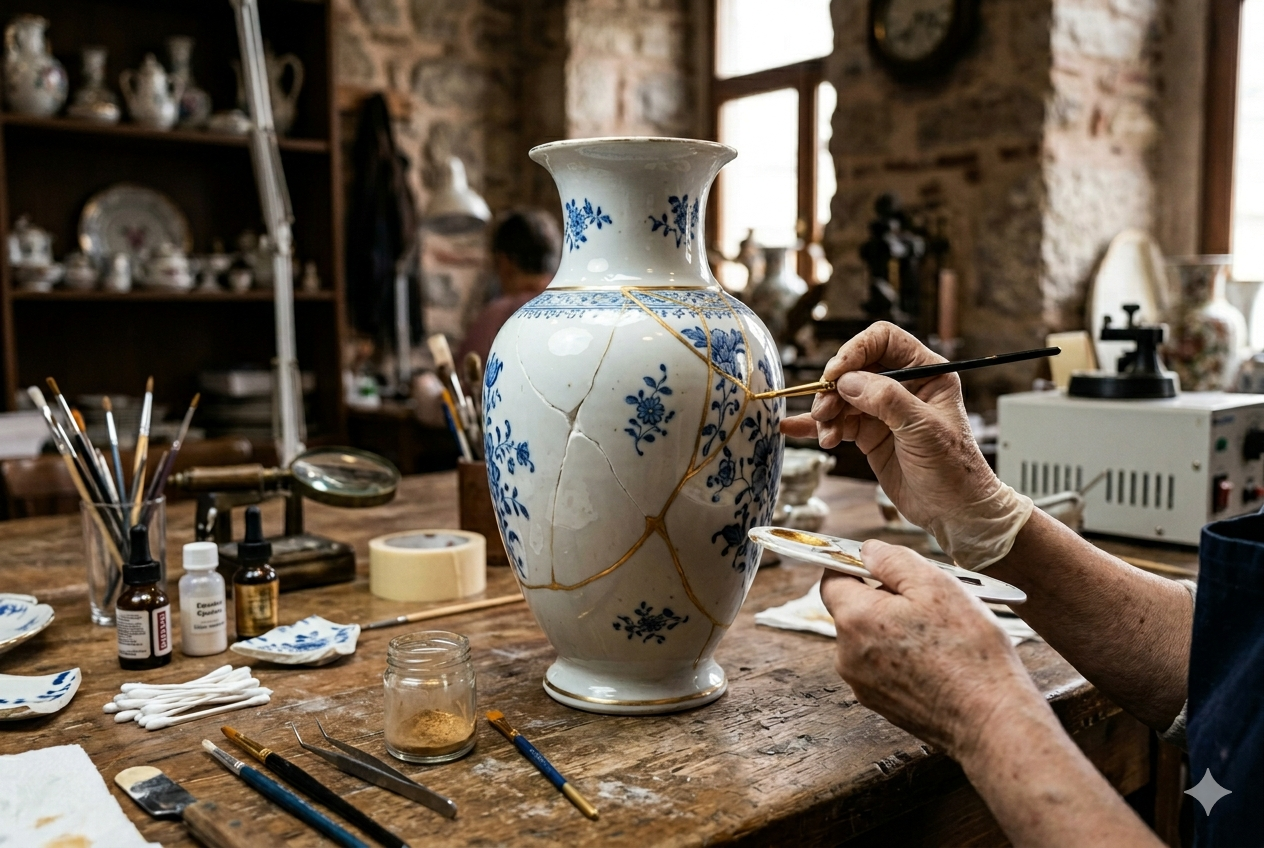
You have a porcelain vase, cup, or figurine that has been passed down through your family for years. One day, it fell from the table, cracked, or a piece broke off. Your first instinct might be to throw it away. But wait — that object might be much more salvageable than you think.
Porcelain repair is a process that requires both technical knowledge and patience, but its results are extremely satisfying. In this guide, we will discuss step-by-step how cracked porcelain is repaired, which methods are used, and why professional antique restoration is important.
Why Is Porcelain a Fragile Material?
Porcelain is a type of clay-based ceramic fired at high temperatures. It stands apart from other ceramics due to its hardness and translucency. However, this hardness is also its greatest weakness: it is not resistant to impact. A fall, a hard knock, or accumulated temperature changes over many years can lead to cracks, breaks, or chipped pieces in porcelain.
Antique porcelains, however, are much more delicate in this regard. Over the years, the material structure changes, the enamel layer thins, and the internal structure weakens. For this reason, antique porcelain restoration requires a much different expertise than standard ceramic repair.
Can Cracked Porcelain Be Repaired at Home?
The answer to this question is both yes and no.
For small, superficial cracks and minor breaks, some temporary interventions can be done at home. However, for porcelain pieces with antique value, decorative importance, or significant loss of material, professional porcelain repair should definitely be preferred.
Incorrect interventions made at home can lead to the following consequences:
- Permanent repair marks due to adhesive residue
- Aesthetic deterioration due to incorrect color matching
- Further damage to the material in the long term
- Decrease in the monetary value of the antique item
For these reasons, "at-home porcelain repair" should only be considered a temporary solution. For a lasting and aesthetic result, it is essential to entrust it to expert hands.
Methods Used in Professional Porcelain Repair
1. Japanese Kintsugi Technique
Kintsugi means "golden joinery" in Japanese. In this ancient technique, broken pieces are joined with a special adhesive mixed with gold, silver, or platinum. According to the Kintsugi philosophy, breakage is not a flaw to be hidden, but a part of the object's history.
This technique is especially preferred for pieces with antique value where the visibility of the repair line is not an issue. As a result, the restored object becomes a work of art rather than just a repaired item.
2. Invisible Restoration
Invisible restoration is the most sophisticated method of porcelain repair. The aim of this technique is to make the break or crack appear as if it never happened. Expert restorers use this method to:
- Use special epoxy resins
- Fill the broken area with colored filler materials
- Complete the surface with special paints that harden under UV light
- Finish the process with varnishes that mimic the enamel layer in the final stage
This method is particularly used in museums, among collectors, and for high-value antique items.
3. Adhesion and Filling Method
In this method, used for simpler breaks, pieces are joined with special ceramic adhesives, and then missing areas are completed with filler material. The important point is that the adhesive used should not yellow in the long term and should be chemically compatible with the material.
Standard superglues sold in the market are not suitable for this purpose. They yellow over time, break, and cause the repair to leave a mark.
Step-by-Step Porcelain Repair Process
A professional porcelain repair consists of the following stages:
1. Evaluation and Documentation
The item is first examined in detail. The type and size of the break, whether there is any loss of material, and the age of the porcelain are determined. Photographs are taken, and if available, the manufacturer's brand and period information are researched.
2. Cleaning
The broken area is cleaned with special solvents. Dust, grease, and residues from previous repairs are removed. This stage is extremely important because adhesion to an unclean surface will not be long-lasting.
3. Joining the Pieces
Broken pieces are slowly and carefully joined with special ceramic adhesives. Precise alignment of the pieces is critically important during this process. Incorrect alignment cannot be corrected later.
4. Filling and Shaping
If there are missing pieces, they are completed with special filler materials. After these materials dry, they are sanded to make the surface smooth.
5. Color Matching and Painting
This is the most delicate point of the restoration process. The expert restorer mixes special paints that perfectly match the original color and texture of the porcelain. This stage can take hours, or even days.
6. Varnishing and Finishing
In the final stage, the surface is coated with special varnishes that will restore the porcelain's original shine. UV varnishes or oven-bake ceramic varnishes are used for this purpose.
Varank Application and Antique Restoration
In recent years, digital processes have increasingly found their place in the field of antique restoration. The Varank application, launched to support handicrafts and traditional professions in Turkey, stands out as a platform that antique restorers and master craftsmen can also benefit from.
Through this application:
- Digital recording of master-apprentice relationships
- Documentation and preservation of traditional crafts
- Access for restoration masters to state-supported training programs
For masters working in a specialized field like antique repair, such digital platforms offer a significant opportunity for both professional development and recognition.
Which Pieces Can Be Repaired, and Which Cannot?
Not every porcelain piece is suitable for repair. As a general rule, the following assessment can be made:
Repairable:
- Breaks divided into a single or a few pieces
- Cracked but structurally intact pieces
- Items with small losses of material
- Pieces with damaged enamel layer but sound structure
Difficult or impossible to repair:
- Items reduced to powder or broken into dozens of pieces
- Pieces with a large portion of their surface destroyed
- Porcelains whose internal structure has deteriorated due to moisture and heat
Points to Consider in Antique Restoration
Before taking your antique item to a restorer, we recommend asking the following questions:
What is the restorer's experience?
Antique porcelain repair requires a different expertise than general ceramic repair. Do not hesitate to ask if the person you are working with has done similar work before.
What materials will be used?
The quality of the adhesives, fillers, and paints used directly affects the outcome. The use of reversible materials allows for future interventions if needed.
Does the repair affect the item's value?
A professionally executed repair preserves or increases the value of an antique item. However, a poorly done repair can significantly decrease its value.
Why Professional Antique Repair?
When it comes to porcelain repair, "do-it-yourself" solutions might seem appealing. However, when dealing with an item passed down through generations, this decision carries a much greater significance.
Professional antique restoration provides you with:
- Preservation of the item's authenticity
- A lasting repair that will endure for many years
- Maintenance of the item's material and sentimental value
- An invisible or aesthetic repair result
If you are looking for a specialized workshop in Istanbul, as Şebnem Taruz Restoration Center, we have brought over 1,000 antique items back to life since 2019. We approach each piece with its unique story, blending technical expertise with an artistic touch.
Frequently Asked Questions
Can cracked porcelain be glued?
Yes, cracked porcelains can be successfully repaired with the right materials and techniques. However, professional support is recommended for a lasting result.
How long does porcelain repair take?
For a simple break, 2-3 days are sufficient. Complex restorations, however, can extend to several weeks.
Can repaired porcelain be used?
Repairs for decorative purposes are durable. However, repaired porcelains are not recommended for daily use.
Where can I get antique repair done in Istanbul?
Şebnem Taruz Restoration Center, serving in the Kadıköy, Çiftehavuzlar area, is one of Istanbul's leading addresses for antique and porcelain repair.
Let's preserve the story of your item together. For detailed information and appointments, you can visit our contact page.